[Meditational verses for the High Holidays]
Also known as [פסוקים וצרופי שמות על דרך הקבלה לראש השנה ולימים נוראים]
by Yaḥya, Avraham, 17th century
- First published:
- 16th century
- Languages: Arabic, Hebrew
- Content type: ManuscriptPrimary source
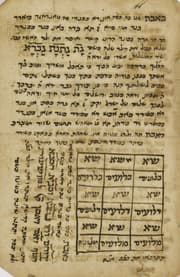
This is a manuscript of a liturgical miscellany with many diverse kabbalistic elements to it. It begins with a silent prayer for the cantor on the High Holidays, supplying verses to meditate on and guaranteeing that the audience will not have a harmful verdict ("gezerah raʻah") for the upcoming year (f. 1r-1v). The prayer ends with additional texts, titled "Ḳabalot", of verses to recite with supplications; the first attributed to R.T. (likely a reference to Jacob of Orléans (died 1189), also known as Rabbenu Tam) and the second attributed to Rav Mosheh ha-Darshan (11th century Narbonne, f.1v-2r). Following this, after a space, is a transcription of a riddle which, by the use of notarikon, claims to develop a definite date for the arrival of the Messiah, based on Micah 2:12; the author attributes this text to "an ancient miscellany ("Ḳovets yashan") written by the wise R. Hai son of R. Sherira Ga'on, [and when] he was asked about the 'end-days of wonders'" ("Ḳets ha-pelaʼot," quoting Daniel 12:6); this attribution is to R. Hai b. Sherira Gaon (Iraq, 939-1038, f. 2r). Following this is a prayer for one to remove unwanted thoughts while praying (f. 3v). Also on that folio is the poem Yedid nefesh, with an inscription in a late 17th-century Sefardic cursive hand, "ידיד נפש לר' אלעזר", or "Yedid nefesh by R. Elazar." Following are the Ten Commandments as written in the Pentateuch (Exodus 20:1-14, f. 3v). Following this is the Tiḳune ha-Zohar chapter 17 (begining "Ribon ha-ʻolamim," f. 4r). Following is a page of commentary of practices for Rosh ha-Shanah and Yom Kippur, from the author's teacher; some of it is attributed to this teacher's correspondence with R.B.L. (unknown reference, f. 4v). Following is a kabbalistic dissertation (titled "Diḳduḳ") involving variations of verses drawn seemingly at random; this is followed by a colophon and the signature of the author (f. 6r). Following this is an amulet text. Following is a chart with terminology for the sefirot, attributed by the author to R. Natan Spira. At the bottom of the folio is further laws pertaining to behaviors for the High Holidays (f. 7r). Following this is a divine prayer with diagrams of the letter ṿaṿ in different vowel structures for the purpose of both recitation and meditation (f. 7v-9r). The manuscript finishes with a prayer for sea travelers to be protected from the dangers of ocean voyages.
Provenance
Why this book is in the catalog
Included because retained bibliographic metadata links this work to Kabbalah and Jewish esotericism.
Controlled discovery queries from colenda matched “Cabala”. Retained metadata contains “zohar” in the description, “Cabala” in the subject metadata, and “zohar” in the edition notes.
- “Cabala”· via Colenda Digital Repository — University of Pennsylvania Libraries
- “zohar”· in description
- “Cabala”· in subject
- “zohar”· in edition notes
Membership records how this book met the catalog’s discovery criteria — relevance to a tradition, not a judgment of the book’s claims.
Read & download
Free, public copies reported by our sources. Links open the source directly.
Colenda item rights: http://rightsstatements.org/vocab/NoC-US/1.0. No Copyright - United States does not determine status elsewhere.
marks a direct file download. Rights vary by country; each source states its own terms.
Buy or borrow
No ISBN on record, so the Amazon link searches by title and author. WorldCat shows libraries near you that hold a copy.
Editions
One edition cataloged here.
| Edition | Date | Publisher | Language | ISBN | Access | Links |
|---|---|---|---|---|---|---|
University of Pennsylvania digitized manuscript 10 leaves : paper ; 150 x 105 mm; Collation: Paper, 10; 1², 2 detached leaves, 2² 3⁴; modern foliation in pencil, 1-10, center left recto.; Decoration: Round enclosures in text ink of ṿaṿ combinations (with different vocalizations) scattered within the text (f. 7v-8v).; Hebrew and Aramaic.; Layout: Written in 18 to 26 lines on unruled pages; the original paper sizes are not determinable due to the clear evidence of trimming at some edges (for example, the bottom part of f. 4r), with other leaves formatted for their current size (for example, f. 3v, 5v); the manuscript may have originated as separate leaves later joined as a miscellany.; Ms. gatherings.; No binding; fragile remnants of sewing. Heavy wear and darkening on the leaves and writing.; Origin: Written likely in northern Italy in the early 17th century by Abraham Yaḥya, or Yaḥiya; perhaps he was a relative of the prominent (and widespread) Yaḥiya family, with roots in 12th century Lisbon whose descendants at this period were prominent in Portugal, Spain, Italy, and Turkey. The dating of the manuscript is based on Yaḥya's friendship with a R. Natan Spira (f. 7r); likely a reference to R. Natan Note Spira of Kraków, a famed kabbalist and author of Megaleh ʻamuḳot, who lived 1585-1633. Also, the poem Yedid nefesh is attributed in this manuscript (f. 3r) to R. Eleazar Azikri (1533-1600), who printed it for the first time in 1600-1 in a volume he authored (Sefer ḥaredim, Venice: Daniel Zanetti, 1600-1601).; Related Work: Azikri, Eleazar ben Moses, 1533-1600. Yedid nefesh.; Related Work: Hai ben Sherira, 939-1038. Ḳets ha-pelaʼot.; Related Work: Jacob, of Orleans, -1189. Ḳabalot.; Related Work: Moses, ha-Darshan, active 11th century. Ḳabalot.; Related Work: Spira, Nathan Nata ben Solomon, approximately 1585-1633. Seder.; Script: Written in an Ashkenazic semicursive script, with highlights in square script, by multiple hands. The portion of text ascertaining the time of the arrival of the Messiah is written in a larger semicursive script, with a more Italian appearance and a lower slant, probably by another hand (f. 2r). One work is signed by the scribe after a small colophon (f. 6r). In the amulet text, the Tetragrammaton with tserufe shemot (formulaic tetragrammaton) is written in very large square script and three rows below, with the titles "śerafim - ḥayot - ofanim" at the ends, are written in vocalized smaller square script (f. 6v).; Table of contents: 880-04 1. f. 1r-1v: [Tefilah] le-mi she-ʻover li-fene ha-tevah be-R.H. ṿe-Y. ha-K. -- 2. f. 2r: Ḳabalah / me-R. Mosheh ha-Darshan -- 3. f. 2r: Heʻteḳ ... meḳubal yashan [ʻal zeman ḳets ha-pelaʼot] -- 4. f. 3r: Tefilah yafah le-omro be-khol yom uve-khol zeman ha-tefilah -- 5. f. 3v: [Tefilah] le-hasir maḥshavot raʻim be-ʻet ha-tefilah -- 6. f. 3r: Yedid nefesh -- 7. f. 3v: [ʻAśeret ha-dibrot] -- 8. f. 4r: [Tiḳune ha-Zohar 17] -- 9. f. 4v: Dinim ha-shayakhim le-R.H. ṿe-Y. ha-K. -- 10. f. 5r-6r: Diḳduḳ [...] le-havin ule-horot amarot ṭehorot -- 11. f. 6v: [Ḳameʻa] -- 12. f. 7r: [Seder] be-khitve / ḥaveri ha-R.N. Śpira -- 13. f. 7v-9r: Seder ha-yiḥud ha-gadol ha-mesugal leha-shanah -- 14. f. 9v: Tefilat ha-yam ʻal kol tsarah she-lo tavo.; Table of contents: 880-04 1. f. 1r-1v: [Tefilah] le-mi she-ʻover li-fene ha-tevah be-R.H. ṿe-Y. ha-K. -- 2. f. 2r: Ḳabalah / me-R. Mosheh ha-Darshan -- 3. f. 2r: Heʻteḳ ... meḳubal yashan [ʻal zeman ḳets ha-pelaʼot] -- 4. f. 3r: Tefilah yafah le-omro be-khol yom uve-khol zeman ha-tefilah -- 5. f. 3v: [Tefilah] le-hasir maḥshavot raʻim be-ʻet ha-tefilah -- 6. f. 3r: Yedid nefesh -- 7. f. 3v: [ʻAśeret ha-dibrot] -- 8. f. 4r: [Tiḳune ha-Zohar 17] -- 9. f. 4v: Dinim ha-shayakhim le-R.H. ṿe-Y.ha-K. -- 10. f. 5r-6r: Diḳduḳ [...] le-havin ule-horot amarot ṭehorot -- 11. f. 6v: [Ḳameʻa] -- 12. f. 7r: [Seder] be-khitve / ḥaveri ha-R.N. Śpira -- 13. f. 7v-9r: Seder ha-yiḥud ha-gadol ha-mesugal leha-shanah -- 14. f. 9v: Tefilat ha-yam ʻal kol tsarah she-lo tavo.; Title supplied by cataloger. | 1600 | — | Arabic, Hebrew | — | Public download |
|
Subjects
More like this
Books that share this work's traditions, subjects, or authors.
- Read free
Nagid u-metsaṿeh
Ẓemaḥ, Jacob ben Ḥayyim, active 17th century
1600Hebrew
- Read free

Sefer ha-ʻasis
Samuel Gallico
1500Hebrew
- Read free
Maḳor ḥayim
Ḥayim ʻOvadyah, -1560
1600Hebrew
- Read free
[Liḳuṭim be-ḳabalah]
1636Hebrew
- Read free
[Shaʻare orah]
Joseph ben Abraham Gikatilla
1500Hebrew
- Read free
[Ḳemiʻot ve-segulot]
1400Hebrew
Kabbalah and Catastrophe
Hartley Lachter
2024

Zohar: The Book of Splendor
Gershon Scholem, Zohar. Français. Extraits, Țicu Goldstein
1949ARC

Sepher Rezial Hemelach
Steve Savedow
2000
- Read free
[ʹAsarah maʾamarot, V-VI]
Menahem Azariah da Fano
1600Hebrew
- Read free
[Adam yashar]
Ḥayyim ben Joseph Vital, Jacob ben Ḥayyim Ẓemaḥ
1600Hebrew
- Read free
[Sefer hekhalot]
1300Hebrew
Identifiers & provenance
How this record was assembled, and the authority identifiers it carries.
Identifiers
- Colenda
- ark:/81431/p3tb0zh1p
Cataloged from
- Colenda Digital Repository — University of Pennsylvania Librariesprimary81431-p3tb0zh1p (opens in a new tab)
Cataloging notes
- Colenda collection: Moldovan Family Judaica Collection (University of Pennsylvania)
- Penn Libraries catalog identifier: 9977510241303681
- Physical location: Library at the Katz Center, Rare Book Manuscripts, CAJS Rar Ms 489
- Provenance: GIFT FROM THE MOLDOVAN FAMILY COLLECTION By Joseph T. Moldovan C'76 and Susan A. Moldovan C'76. Donated in Honor and Memory of Jean and Dr. Alfred Moldovan.; Moldovan, Joseph, donor.; Moldovan, Susan, donor.
- Rights: http://rightsstatements.org/vocab/NoC-US/1.0
- Catalog id
- colenda:81431-p3tb0zh1p
- Edition coverage
- Colenda source record
- Retrieved